Moss in Your Window Tracks — What It’s Actually Doing to Your Seal
A note before this one starts: most of what’s written online about moss and windows is really about roof and gutter moss — different surface, different growth pattern, different removal method. Window-track moss specifically is a thinner topic to find good source material on, and we want to be upfront that this post leans more heavily on direct professional experience than on a wide base of independently published sources. Where a claim is well-supported, we say so; where it rests on a single real source, we say that too.
100+ REVIEWS |
INSURED & BONDED |
100% SATISFIED CLIENTS
Is moss in a window track actually different from moss on a roof?
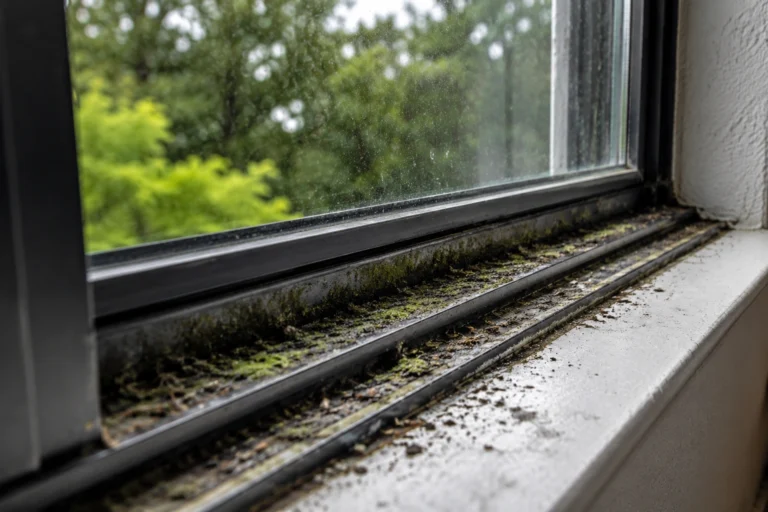
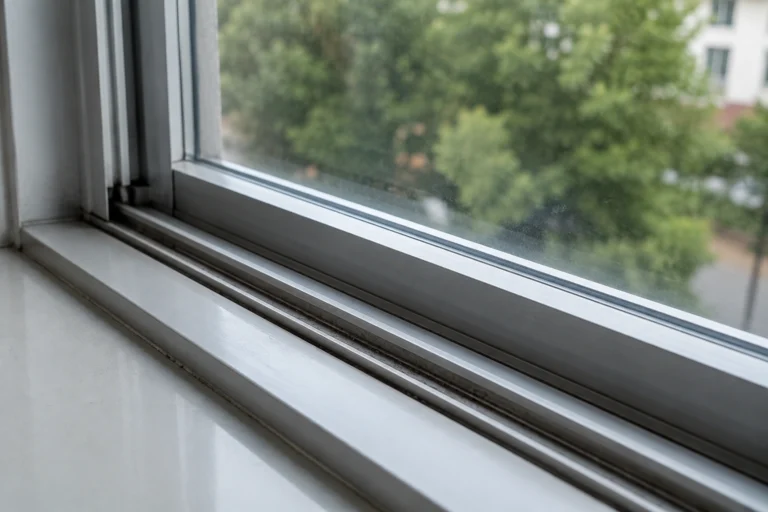
Yes, mechanically. Roof moss sits on an exposed, largely flat surface and is generally treated as a surface-level problem — scrub, treat, rinse. Window track moss grows inside a narrow, enclosed channel that’s in direct, sustained contact with the window’s seal. That’s a meaningfully different situation: the moss isn’t just sitting nearby, it’s rooted in the same tight space the seal occupies, with nowhere for trapped moisture to go.
Can moss actually damage a window seal, or is that just a cosmetic issue?
Based on direct professional experience shared by a Pacific Northwest window cleaner, yes — moss that establishes inside a window track can physically attach to and stress the seal along the window’s edge, and left long enough, that stress is described as a real contributor to seal breakage and water intrusion between panes. We want to be direct that this is currently the strongest specific source we have connecting track-level moss to seal failure — it’s a real, first-hand professional account, not a generic claim repeated across many sites, but it’s also not yet something we’ve been able to independently confirm across multiple separate sources the way we can for some other claims on this site.
What does lend it real credibility, though, is a separate and independently confirmed mechanism: professional window cleaners describe prolonged dirt and moisture sitting directly on a seal as something that can degrade the seal material over time, even without moss specifically in the picture. Moss in a track is, in effect, a more extreme, more persistent version of exactly that condition — organic material that holds moisture against the seal continuously rather than intermittently. The underlying physics lines up even where the moss-specific data is thinner than we’d like.
What does early-stage track moss actually look like?
Before it’s an obvious green clump, track moss often starts as:
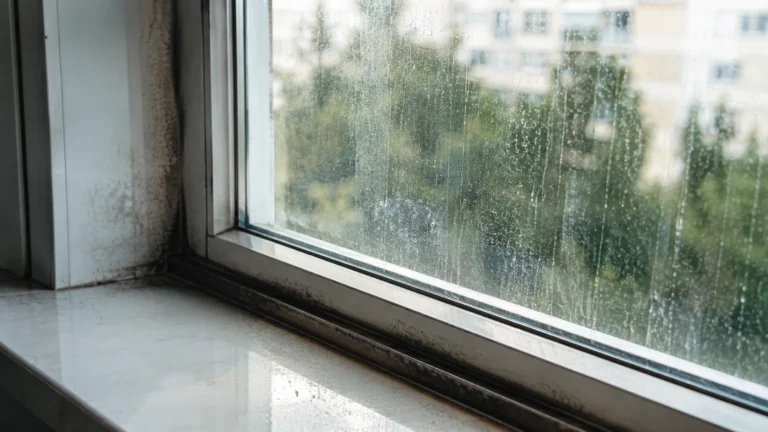
- A faint, dark green-black film in the corners of the track, not yet raised or textured
- A window that’s very slightly harder to slide than it used to be, easy to dismiss as “just needs oiling”
- A musty smell near the window that’s stronger than the rest of the room
By the time moss is visibly thick and rooted, it’s had time to establish in exactly the space where seal contact happens.
Should I try to remove window track moss myself?
Carefully, and not aggressively. Dry-brushing loose material out with a stiff nylon brush or old toothbrush is reasonable for surface debris. What we’d caution against is aggressive scraping with a metal tool on a painted or PVC track, or pressure-washing the track directly — both risk damaging the track or seal further, which defeats the purpose. If the moss has clearly rooted rather than sitting loose on the surface, that’s a reasonable point to have it assessed rather than push harder yourself.
How often should window tracks be checked for moss in Portland specifically?
Given Portland’s rainy season and heavy tree canopy in many neighborhoods, a reasonable interval is checking tracks each time windows are cleaned — twice a year for most homes, more often for heavily shaded properties — rather than waiting until moss is visibly established. Catching it at the faint-film stage, before it’s rooted, is a meaningfully easier problem than treating moss that’s already reached the seal.
Got Questions?
We’re happy to help. If you can’t find the info you’re looking for, please don’t hesitate to reach out to us!
Call us (323) 831-1260
Book a Moss Inspection — see our full Moss & Algae Removal Portland page for pricing and process.