White Milky Residue on Windows: Hard Water vs. Frame Oxidation
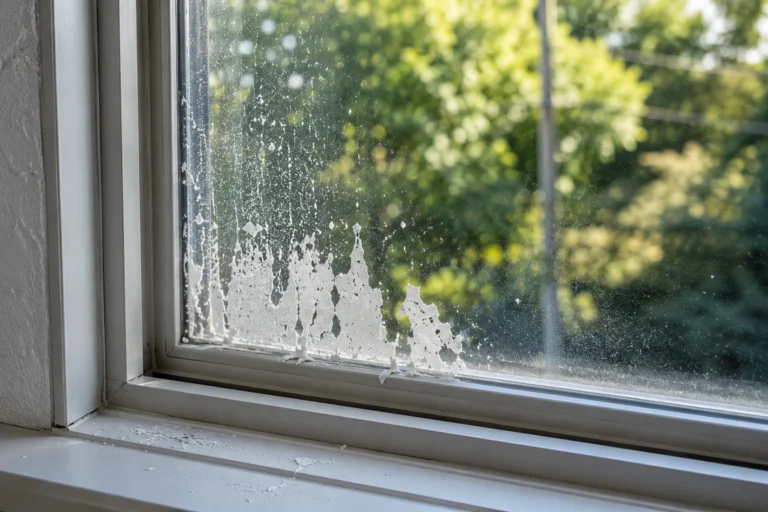
A chalky, whitish film on your windows can come from two genuinely different problems — mineral deposits left behind by water, or oxidation bleeding off an aging metal frame — and they call for different fixes. Here’s how to tell them apart and what actually works for each.
100+ REVIEWS |
INSURED & BONDED |
100% SATISFIED CLIENTS
What causes white milky residue on windows?
The two most common causes are hard water deposits and frame oxidation. Hard water residue forms when water containing dissolved minerals (mainly calcium and magnesium) evaporates off the glass and leaves the minerals behind. Frame oxidation happens when a metal window frame — most often aluminum — corrodes from ongoing moisture exposure, and that corrosion bleeds outward onto the adjacent glass. They can look similar at a glance, but they behave differently and need different solutions.
How can you tell hard water residue from frame oxidation?
Hard water residue tends to look:
- Random or splash-shaped, concentrated wherever water pools or sprays
- Confined to the glass itself, not the frame
- Removable, at least partially, with the right cleaning approach
Frame oxidation tends to look:
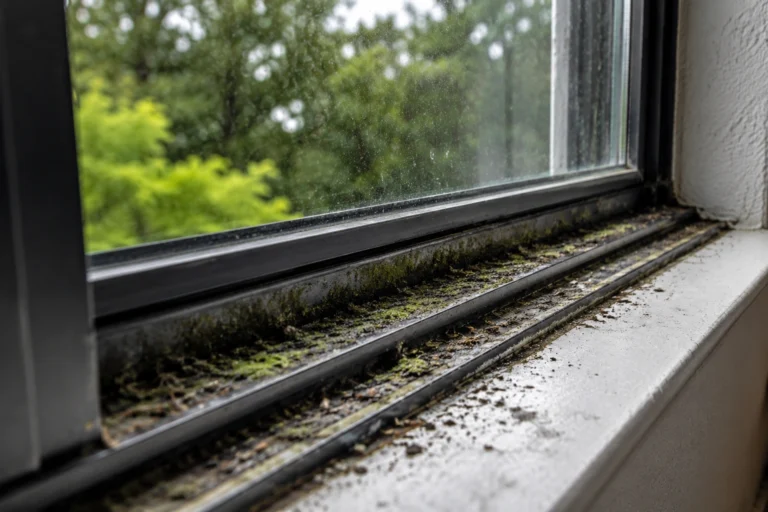
- Streaked or discolored starting at the frame edge and fading onto the glass
- Shaped like the frame itself — along a bottom rail or around corners
- Resistant to ordinary glass cleaning, since it’s a byproduct of the frame breaking down rather than something sitting on the glass surface
How do you remove hard water stains from windows?
For light deposits, a mineral-specific glass cleaner and a soft cloth is usually enough. For heavier buildup, the safer approach is to test an inconspicuous area first, then work the deposits gently — while wet, never dry — with a very fine-grade steel wool (000 or 0000) or a dedicated hard water stain remover. Dry abrasion is what actually scratches glass, so keeping the surface wet during the process matters. If the deposits have etched into the glass rather than sitting on top of it, cleaning won’t reverse that — at that point it’s a glass restoration or replacement question, not a cleaning one.
Can frame oxidation be cleaned off the glass?
Partially, and often temporarily. The same gentle, wet cleaning approach used for hard water can reduce oxidation residue on the glass, but if the frame itself is still actively corroding, it will keep bleeding onto the glass again over time. Older, uncoated aluminum frames are the most common source; newer vinyl or coated frames rarely have this problem. Lasting oxidation staining is fundamentally a frame issue, not a glass issue — addressing it usually means treating or replacing the frame rather than repeatedly cleaning around it.
Does white residue on windows mean I need new windows?
Not necessarily. Hard water deposits sitting on the glass surface are typically a cleaning problem with no replacement needed. Etched glass or an actively corroding frame are the two scenarios where cleaning alone won’t solve it long-term — in those cases, a professional can tell you honestly whether you’re looking at a quick clean or a frame/glass repair conversation.
Got Questions?
We’re happy to help. If you can’t find the info you’re looking for, please don’t hesitate to reach out to us!
Call us (323) 831-1260